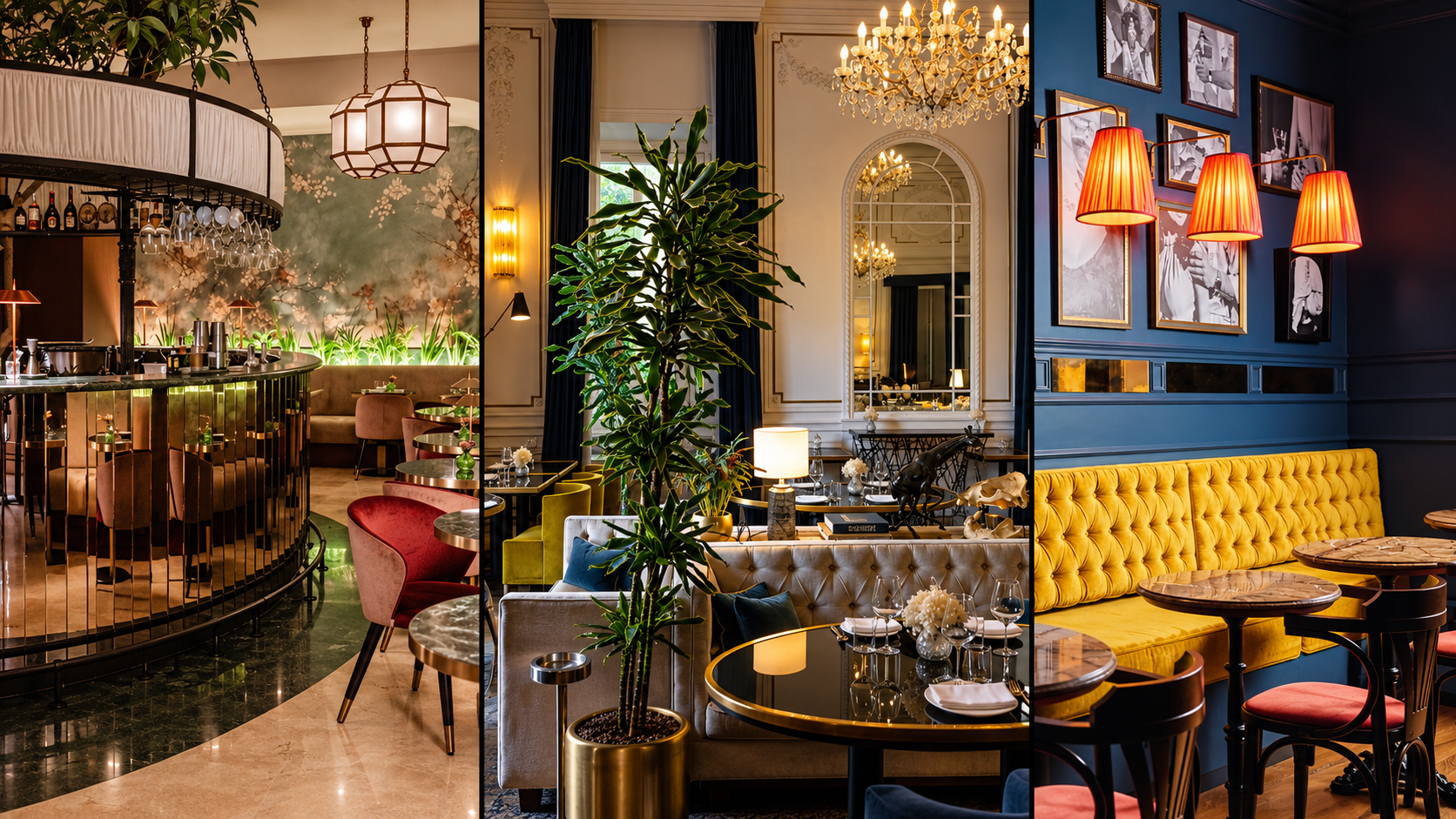
Bruno Verjus will close his two-Michelin-starred Table in Paris, declaring that a model that has become too exclusive, expensive and distant from the present has come to an end. But the desire for haute cuisine has not disappeared: it has changed its clothes. Rome’s new openings — Donkey’s Bar, HausBar and A’ Mano — tell the story of freer, more convivial and accessible dining, in which signature dishes and mixology share centre stage. Fine dining is not dying: it is stepping down from its pedestal and taking a seat at the counter.
“Fine dining is dead.” When a statement like this comes from Bruno Verjus, it cannot be dismissed as a provocation made for social media. The French chef has announced that on 22 December 2026 he will serve the final dinner at his two-Michelin-starred Paris restaurant Table, opened in 2013 and now one of the world’s most celebrated — and expensive — restaurants.
The single “Couleur du jour” menu costs €480, excluding drinks; pairings can add between €200 and €400. It is an experience of ten to fourteen courses that Verjus has built around ingredients, producers and the idea that a meal can change the way we look at the world. Yet he himself has admitted that he no longer feels comfortable with a model capable of including only a very small number of people.
His decision does not appear to be a surrender to cooking, but rather the abandonment of a form that has become too restrictive. Verjus wants to continue feeding people through extraordinary ingredients, knowledge and talent, but “in a completely different way.” The target is not excellence: it is the system of rituals, prices and distances that, in some cases, has transformed it into a ceremony for initiates.
The Problem Is Not Eating Well
Fine dining has long been going through an identity crisis. Tasting menus have become longer, costs have risen and dining-room rituals have sometimes ended up mattering more than the guest’s pleasure. Meanwhile, behind the scenes, large brigades, exhausting shifts, difficulties in finding qualified staff and fragile profit margins have undermined the economic and human sustainability of the model.
There are restaurants one enters with the feeling of having to sit an exam. The guest listens to the explanation, follows the established journey and respects its timing and sequences. They admire, photograph and sometimes become emotional; they do not always have fun. Haute cuisine, created to offer an exceptional experience, thus risks producing an almost “alien” distance from the rhythms of contemporary life.
But a crisis of the container does not amount to the death of its content. The desire to eat and drink well, to recognise great technique, to encounter intelligently selected ingredients or to be surprised has not disappeared. What has changed is the way people want to experience all this: less awe and more freedom; less imposed storytelling and more conversation; shorter menus, the possibility of sharing and, above all, the right to stop even just for one dish and a cocktail.
Eugenio Boer, chef-patron of Bu in Milan, responded to Verjus’s de profundis by pointing out that there has never been just one formula for haute cuisine. Fine dining, he argues, is fluid: it can inhabit a solemn dining room or a counter, preserve memory or break the rules. What may die is a crystallised vision, not gastronomy’s ability to reinvent itself.
Rome and the Path of “Pop Fine Dining”
Rome’s new openings indicate one of the possible directions. They do not give up quality, research or expertise, but transfer them into venues where the cocktail bar is no longer merely the restaurant’s antechamber. It becomes the setting for the experience: a more relaxed, transversal and accessible space, where cuisine and mixology interact without one having to limit itself to accompanying the other.
It is a kind of pop fine dining, if by “pop” we do not mean simplified or banal, but capable of speaking to a broader audience. One can arrive at aperitivo time, order two dishes to share, stay for dinner or stop only at the counter. One does not necessarily purchase a closed experience: one builds one’s own evening. Three establishments tell the story of this transformation in three different forms.
Donkey’s Bar: The Trattoria Puts On Its Best Clothes
At Palazzo Dama, a historic villa overlooking the Tiber and the gardens of Villa Borghese, Donkey’s Bar defines itself as a “fine trattoria.” The expression already contains its challenge: to bring the memory of Italian and Lazio cuisine into an elegant and cosmopolitan setting, while preserving its immediacy, warmth and recognisability.
The gastronomic project bears the signature of Daniele Lippi, chef of the two-Michelin-starred Acquolina restaurant. But his technical expertise is not used to make the dishes unrecognisable. On the contrary, it serves to restore energy to familiar flavours: Roman-style battered courgette flowers, supplì with giblet ragù, gnocchi filled with chicken cacciatore, meatballs in tomato sauce and chicken with peppers to share.
It is haute cuisine that does not ask to be contemplated in silence. The dishes arrive at the centre of the table, sharing replaces the rigid succession of courses and the cocktail bar extends the experience beyond traditional restaurant hours. Luxury does not lie in complication, but in the possibility of rediscovering an understandable taste executed with precision.
HausBar: Time Is Measured, Then Forgotten
HausBar was born from the encounter between the Jerry Thomas Project, one of the names that changed Italian mixology, and Hausmann & Co., Rome’s historic watchmaking house. Two worlds linked by precision, gesture and ritual, brought together in an urban lounge open from 11 a.m. until 2 a.m.
Here, the cocktail is prepared with the same care used to regulate a mechanical movement, but without turning the counter into an altar. The promise is summed up in one sentence: “We measure time. It is up to you to forget it.”
The cuisine is designed to accompany, not to compete. Drinking and eating become a single ritual, free from the divisions between late breakfast, lunch, aperitivo, dinner and after-dinner drinks. HausBar interprets the new luxury as the availability of time: staying, talking and ordering something else without being trapped by a predetermined duration or compulsory journey.
This is perhaps the quietest revolution: applying the same rigour of fine dining to the glass and the plate, while allowing the guest to decide the pace.
A’ Mano: Haute Cuisine Becomes Sharing
A few steps from the Pantheon and Piazza Navona, inside Dimora Coppelle, A’ Mano chooses the language of Italian tapas. These are not small bites used as filler during aperitivo, but dishes designed to make up a dinner without forcing everyone to follow the same path.
Whipped salt cod with Tuscia olive oil, artisanal seafood charcuterie from the Tyrrhenian Sea, a savoury maritozzo with mantis shrimp and bottarga, and half-moon pasta filled with octopus coexist with carbonara, amatriciana and cacio e pepe. Roman tradition encounters contemporary techniques and ingredients, but remains recognisable.
The cocktail list also speaks Italian. Fellini reinterprets the Martini, Camillo pays tribute to the Negroni, while Anita combines rum, Cognac, hazelnut, cocoa and liquorice. On Thursdays, with the Coppelle Roman Club, live music, drinks and food transform dinner into a social gathering.
A’ Mano probably represents the most explicit form of this new hospitality: elegance without rigidity, quality without the obligation of solemnity, and the freedom to share or build a personal dinner, one dish and one glass at a time.
The Cocktail Bar as a Laboratory for the Future
The cocktail bar possesses certain advantages that the traditional fine-dining restaurant has often forgotten. It allows for short visits or long evenings, welcomes different budgets and desires, encourages conversation and makes the blending of cuisine, music, design and drinking culture feel natural.
Above all, it puts the guest back at the centre. It does not necessarily ask them to place three hours and hundreds of euros in the chef’s hands. It allows them to decide how much to spend, what to taste and when to leave. The authority of the cuisine does not disappear, but it stops expressing itself through imposition.
Of course, adding a few small dishes to a drinks list is not enough to reinvent fine dining. It requires technique, ingredients, trained staff, a dining room capable of listening and mixology that is not merely ornamental. Donkey’s Bar, HausBar and A’ Mano are interesting precisely because they try to build a complete identity: neither restaurants with cocktails nor bars serving food, but places in which the two experiences become inseparable.
Fine Dining Is Not Dead: It Has Changed Places
Perhaps Verjus is right if by fine dining we mean endless menus, prohibitive prices, exhausted brigades and an idea of luxury based on distance. That model cannot continue to live simply because awards, rankings and rituals have made it familiar.
But fine dining does not coincide with its most formal attire. It is research, knowledge, precision, a culture of hospitality and the ability to transform ingredients and gestures into an experience. All this can survive in an elegant trattoria, in front of an Italian tapa or on a stool, with a cocktail in hand.
Rome’s new openings do not celebrate the death of haute cuisine. They show one possible rebirth: more convivial, flexible and human. The chef does not give up their vision, but stops asking the guest to kneel before it. Fine dining, in short, is not dead. It has simply left the most important table in the dining room and taken a seat at the counter, beside us.