
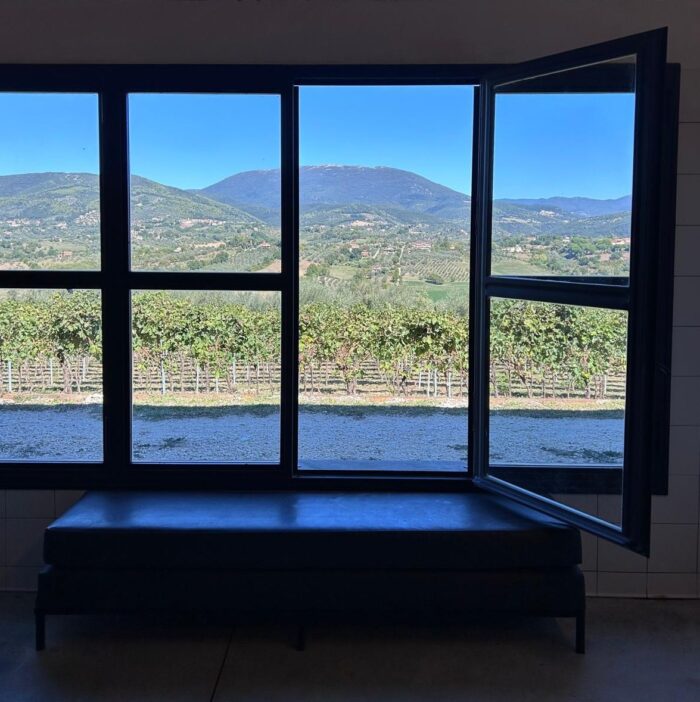
In Tarano, in the Rieti area of Sabina, in 2007 Leonardo Sassi took on an inheritance made above all of memories: his grandfather’s vineyard, the olive trees, the pond and the days of his childhood. By opening a window onto what that land could become, he transformed a family heritage at risk of abandonment into an organic farming project. The first bottles came in 2017, followed by artisanal wines, the bubbles of “Evviva!”, olive oil and, soon, his first Traditional Method sparkling wine.
An open window onto the family land
Not all inheritances can be measured in hectares, buildings or land value. Some are valuable for what they preserve: a road travelled as children, a vineyard observed through the window of a white Fiat Uno, his grandfather’s animals, the olive trees, the pond and the fruit trees. Leonardo Sassi’s family landscape was made of all this.
“This land belonged to my grandfather Antonio,” Leonardo says. It was a place from his childhood that, for years, had remained almost motionless, exposed to the risk of abandonment. In 2007 came the decision to take it in hand. Not so much to save financial capital, but to prevent an emotional heritage from being lost: the bond with his family, with memory — how much of it we have lost — and with an authentic way of experiencing the countryside.
Vision, after all, is the ability to open a window where others see only a wall. Courage means looking out, imagining what does not yet exist and then beginning to build it. In Leonardo’s case, beyond that window there was a vineyard to restore, olive trees to prune, rural buildings to bring back to life and a countryside to which a future had to be restored. And between saying and doing there is no sea — nor even the countryside — there is courage.
Before even thinking about the bottles, Leonardo had to reassemble a rural organism: restore the land, replant cypress and fruit trees, bring the olive grove back into production, cultivate the vegetable garden and bring back the animals. Because, as he says, “the countryside must be alive.”
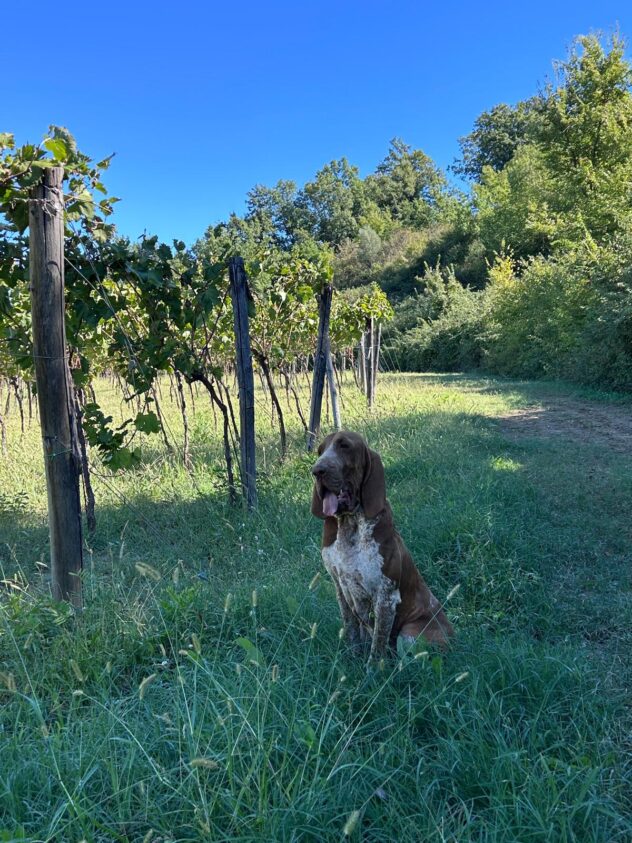
At Podere Sassi it truly is, also thanks to its mascots: Teo, the Italian Pointer; Cipolla, the Maremma Sheepdog; two horses, two ponies and Carolina, the little donkey. They are not ornamental presences, but genuine inhabitants of the estate, interpreters of that blend of agriculture, nature and everyday life that Leonardo wanted to recreate and that evokes a past which no longer exists, except in remote places. Brought back to life less than an hour from Rome.
Tarano, a part of Sabina still waiting to be discovered
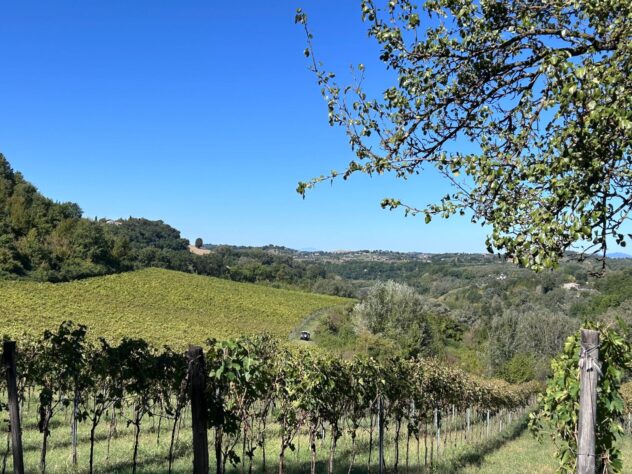
Podere Sassi is located in Tarano, in the lower Sabina area, in the province of Rieti, on the western edge of the Sabine Mountains and not far from the border with Umbria. It is hilly countryside, located at an altitude of around 300 metres, protected by the pre-Apennine hills and influenced by the nearby Tiber Valley.
Here, sunshine and ventilation accompany a succession of clay, sand and silt soils. It is an agricultural landscape without a dominant monoculture, where vineyards, olive groves, arable land, pastures, woods and hazelnut groves continue to coexist. Podere Sassi’s twenty-six hectares clearly reflect this diversity: around 3.6 hectares are devoted to vines, just over 3 to olive trees, while the remainder includes hazelnut groves, arable land, meadows, pastures and woodland. Hedges, brambles, oak trees, wild lavender, mint and a small pond are not decorative elements, but parts of an ecosystem that Leonardo has chosen not to simplify.
Since 2007, the estate has been managed according to organic farming principles and certified by Bioagricert. Work in the vineyard is carried out mainly by hand, from pruning the shoots to harvesting the grapes in small crates. Green manure is practised in winter, an ancient agricultural technique that consists of growing specific plants to improve the fertility, structure and chemical composition of the soil; in spring, copper and sulphur are used in limited quantities and only when necessary. The height of the old Guyot training system — the height of the vine trunk — between 90 centimetres and one metre, has also been preserved: it promotes air circulation, reduces humidity around the bunches and even helps to protect the grapes from incursions by wild boars.
More of a “wine-culturist” than a winegrower
Defining Leonardo merely as a producer would be reductive. He is, if anything, a “wine-culturist”: he cultivates the vine, but above all observes its reactions, follows its rhythms and continues to question himself about what he could do differently.
In 2017, ten years after the agricultural restoration project began, the first officially bottled vintage arrived: just 2,520 bottles, produced in the old cellar in Montebuono, the village of his paternal origins. In 2022, the new winery was completed, built on the spot where the large stable once stood, next to the small vineyard called “12 Tribù.”
Technology is not used to correct the wine, but to allow the grapes to express themselves without forcing them. Fermentations begin spontaneously thanks to indigenous yeasts; temperature control is not used, the wines are unfiltered and sulphur dioxide is kept to a minimum. His grandfather’s old concrete vats have also been recovered.
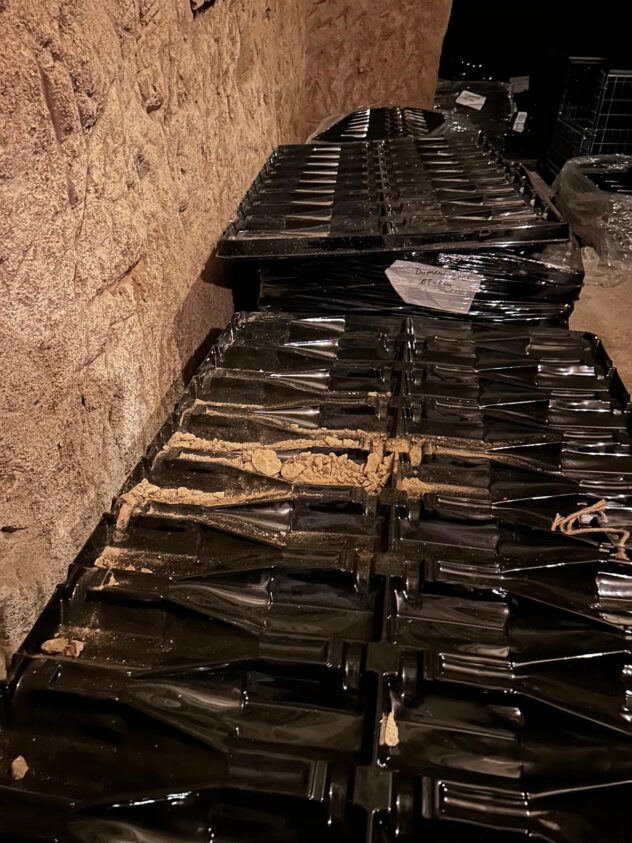
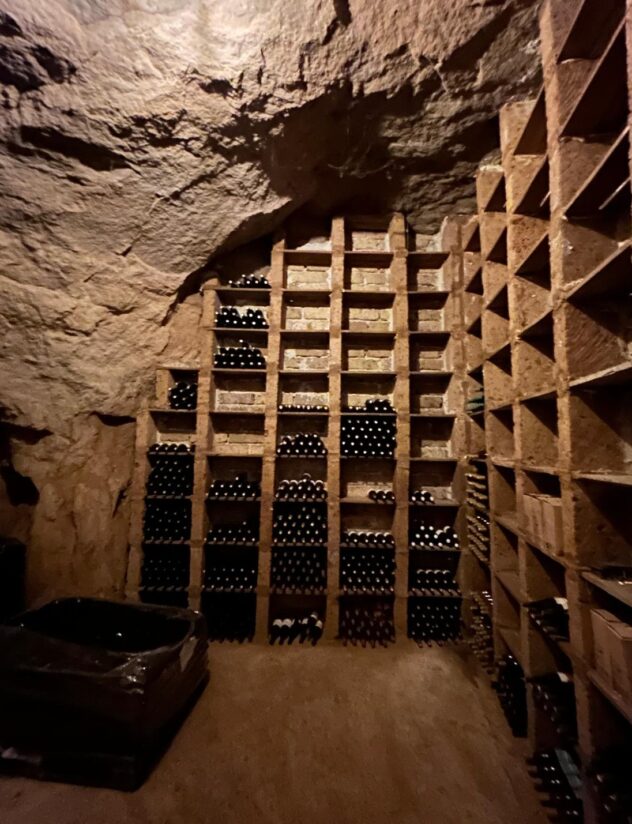
The bottles’ journey, however, does not end in the cellar. After vinification, they are transferred to a tuff cave, an ancient quarry enlarged by hand in the early twentieth century and also used as an air-raid shelter during the war. Here, the wines age in darkness and at a naturally constant temperature throughout the year. It is an environment that no air-conditioning system could make more authentic: the rock protects the bottles and time can carry out its work without sudden fluctuations.
Leonardo’s curiosity can also be recognised in the labels, designed by Leonardo himself and linked to episodes, desires and fragments of his life. “Coraggio”, made from Malvasia del Lazio and Trebbiano Giallo, seems almost to be the estate’s manifesto. Then there are the Sangiovese of “I Sogni,” the Ciliegiolo of “Portami Via,” the Cesanese of “Domani,” the rosé “A Riveder le Stelle,” the more immediate wines of the “Casa Mia” line and “A Piccoli Passi,” a skin-contact white wine also made from Malvasia and Trebbiano.
“Evviva!”, bubbles without tricks
Among the bottles that best express the desire to experiment is “Evviva!”, a sparkling rosé made mainly from Ciliegiolo. After the grapes are pressed directly, the wine is transferred to stainless steel. Refermentation takes place in the bottle thanks to the addition of frozen must obtained from the same grapes: with the warmth of spring, the yeasts reawaken and naturally produce the bubbles. No external sugars, no filtration and a sediment that remains part of the wine, rather than a flaw to be concealed.
The drive towards bubbles does not stop here. Leonardo is working on his first Traditional Method sparkling wine, which is due to see the light of day soon. It is a coherent step for someone who considers every harvest an opportunity for study, rather than an automatic replica of the previous one. Another window opened onto a new possibility, without closing the one that looks back towards his origins.
The same principle applies to the olive trees. Carboncella, Moraiolo, Frantoio, Leccino, Pendolino and Leccio del Corno grow in the approximately three and a half hectares of olive groves. Some of the trees date back to the early 1960s and were already tended by his grandfather Antonio. The olives are harvested manually and with electric harvesting tools, then taken to the organic olive mill within a few hours. The extra virgin olive oil is mechanically extracted at low temperatures and left unfiltered: another product born from the desire to preserve before transforming.
Courage as a daily practice
Leonardo Sassi does not have the attitude of a winemaker created at a desk; he speaks to you directly, with a sincere, welcoming and deeply genuine smile, marked by simplicity, and when he talks about his land, he always returns to the people who inhabited it before him. He is authentic, straightforward and cheerful, like his wines, which are capable of revealing themselves without disguises and without any need for special effects.
Podere Sassi’s most interesting achievement is not merely having created its own labels of organic wine and olive oil in less than twenty years. It is having demonstrated that a memory can become a project, provided that nostalgia is accompanied by work, patience and the desire to take risks — those who have lost it do not live, they survive.
Leonardo had the vision to glimpse a window when that countryside seemed to offer no way out; he then had the courage to open it and let fresh air enter, without losing what was already inside the room: the memory of his grandfather and his family identity.
If a hero of our time can also be someone who chooses not to abandon a vineyard, who saves his grandfather’s trees and restores a future to a small patch of countryside, then Leonardo Sassi is one in the most concrete and least rhetorical meaning of the term: a small, great hero of our time.